PRODUCT PORTFOLIO
- Andrew Spencer
- Mar 23
- 7 min read

ARE YOUR PRODUCTS STILL FIT FOR PURPOSE?
How can you review your product portfolio and find your next opportunity for growth?
As every industry does the built environment moves in cycles. Procurement windows open and close. Regulations change and tighten. Specification demands change.
Products that were flying of the shelf three years ago can become the wrong answer to today's problems. If you're not paying attention, you might not notice until it starts to show on your pipeline.
The question to ask is when did you last properly review your product portfolio, not just on what's selling, but why and for how long?
WHAT IS A PRODUCT LIFE CYCLE, AND WHY DOES IT MATTER?
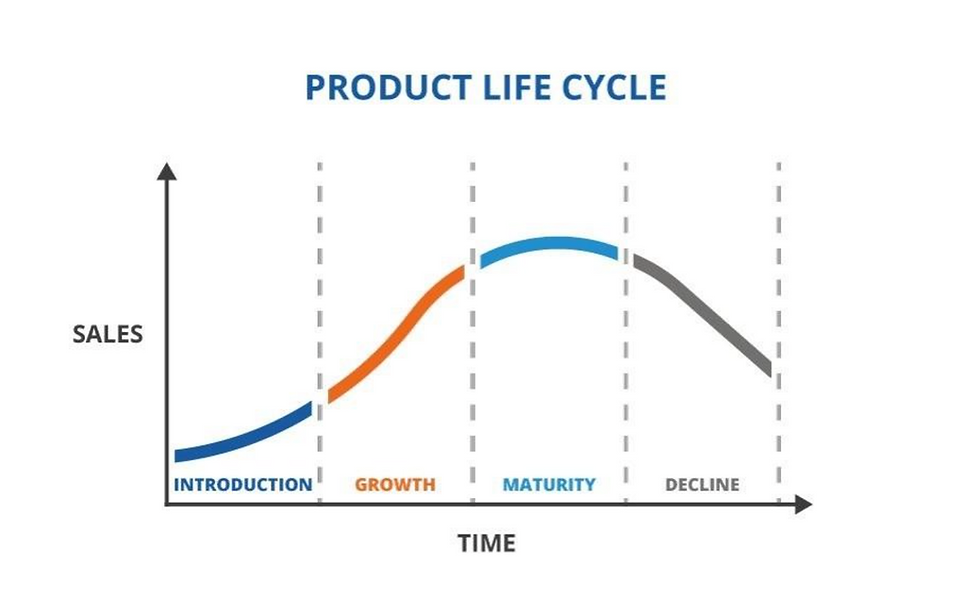
The Product lifecycle is a framework that describes the journey every product no matter the industry, goes through from the moment it enters the market to the point of where it exits.
A product lifecycle has four stages:
Most products do not move neatly through these stages in a straight line. External forces a change in regulations, changes in client demands, and sustainability requirements, can accelerate or disrupt the natural progression. A product sitting comfortably in maturity can find itself pushed towards decline faster than expected if the market changes it needs.
Understanding where each of your products sits in this cycle changes how you should be managing it. A product in growth needs investment to capitalise on momentum. A product in maturity needs active differentiation to avoid commoditisation. A product in decline needs a clear-eyed decision: invest to extend its life, reposition it for a different market, or plan an orderly wind-down that does not disrupt your clients. The biggest challenge within the built environment is the long term specification to installation timescales, which means that the product can be in decline or industry demand can change before it is even on site.
A product can still be appearing in specifications that were written eighteen months ago, even as it is quietly being written out of new ones. This lag makes deliberate lifecycle management more important, not less.
RECOGNISING DECLINE BEFORE IT BECOMES A PROBLEM
Product decline rarely happens over night in the built environment. Its not like the tech or clothing industry where a product can go from highest of highs to the lows within a week or two.
It tends to be gradual, masked by long specification cycles, framework agreements, or loyal clients who keep coming back out of habit rather than preference.
But the signals are there if you know what to look for:
Specification rates are holding steady, but conversion to order is dropping
You're winning on price more often than on product merit
Competing products are being written into project specs where yours used to be the default
Your technical team is fielding more and more compliance or performance queries
Net zero and building safety requirements are exposing limitations in legacy products
That last point is increasingly important. Products that were fully compliant and commercially strong five years ago can now find themselves out of step with where the market is heading, particularly as Part L, the Building Safety Act, and sustainability targets reshape what clients and specifiers expect.
A useful discipline: for each product in your range, ask whether it would make your shortlist if you were designing your portfolio from scratch today. If the honest answer is probably not, that is a conversation worth having sooner rather than later.
Decline is easiest to manage when it is caught early. By the time it shows in your revenue, your options are already narrower.
SPOTTING WHERE YOUR REAL GROWTH OPPORTUNITIES SIT
Growth doesn't always come from launching something entirely new. More often, it comes from looking carefully at what you already do and asking where you can capitalise on.
The products that are performing the best deserve continued investment. Products that have a strong share in a slowing or competitive market need a clear look at. Are they genuine cash generators or are they quietly consuming resources?
Beyond the numbers, the best growth conversations tend to come from three questions:
Are there project types or procurement routes where we are under-represented, despite having a relevant product?
Are there related products or systems, where our existing client relationships give us a natural route in?
Is there a version of our product that serves a different market tier: a premium specification option, a value-engineered variant, or a fully configured system rather than components?
In sectors like facades and M&E in particular, the shift towards whole-life performance, integrated systems, and design-for-manufacture is creating genuine space for businesses willing to think beyond the individual product and towards the solution. That is a significant opportunity for those positioned to take it.
BENCHMARKING AGAINST THE MARKET WITHOUT LOSING YOUR EDGE
Competitive benchmarking can be difficult, not all your competitors are always the ones with the same product.
Good benchmarking starts by being honest about what you are actually competing against. It gets you to ask the right questions:
Where are we losing out on specifications and why?
What are competitors offering in terms of technical support, BIM content, CPD, or sustainability data that we are not?
How does our product perform on the criteria that actually drive specification decisions: thermal performance, fire compliance, acoustic ratings, embodied carbon, or maintenance burden?
Are there pricing or lead time gaps creating vulnerability in sectors we consider core?
In the current environment, sustainability credentials have become a genuine differentiator across all sectors from structural products through to fit-out. EPDs, recyclability data, and whole-life carbon figures are increasingly expected rather than optional extras. If your competitors are producing this data and you are not, that gap will cost you specifications.
The most useful benchmarking question is not 'how do we compare?' It is 'what would make a specifier choose them over us, and what would it take to change that?'
BUILDING A FEEDBACK LOOP THAT ACTUALLY INFORMS DEVELOPMENT
The built environment has a particular challenge with feedback: the distance between product specification and on-site installation can be eighteen months or more. By the time performance issues or installation challenges surface, the decision-makers who specified the product have often moved on to the next project.
This is why deliberate feedback loops matter so much and why informal channels alone are not enough. The most valuable sources of insight are often not the ones that come to you automatically:
Contractors and installers: they handle the product day-to-day and have strong views on what works and what does not but they are rarely asked
Architects and engineers after project completion: post-occupancy conversations can reveal performance gaps that pre-specification conversations never surface
Clients who switched away from your product: what did they choose instead, and what drove that decision?
Your own technical and specification support team: the questions they field repeatedly are often the clearest signal of where a product is falling short
One pattern to watch for specifically: if contractors are consistently developing workarounds for the same installation challenge, that is a product development opportunity sitting in plain sight. In sectors like fit-out and M&E especially, ease of installation is a genuine competitive differentiator, not just a nice-to-have.
Build feedback into your project lifecycle process, not just your annual product review. The insight is most useful while there is still time to act on it.
MAKING IMPROVEMENT AND INNOVATION A HABIT, NOT A ONE-OFF
The constant pull of every business: The pipeline demands attention now, but the products that will win specifications in three years need development time today. When those two priorities compete for the same resource, the pipeline almost always wins and the portfolio quietly falls behind. (The reason NOVA was created).
A few structural approaches that help break this cycle:
Separate your improvement budget from your new development budget. Iteration on existing products and genuinely new development have different risk profiles and timescales treating them as the same pot means neither gets managed well
Set a portfolio review cadence and protect it. Whether quarterly or twice a year, a standing review moment creates accountability and surfaces issues before they become emergencies
Use pilot projects and early adopter clients to test development ideas in real conditions before committing to full range changes, particularly valuable for technical products where performance claims need to be evidenced
Track regulatory and market signals systematically, not reactively. Building safety reform, Future Homes Standard progression, and embodied carbon requirements are not surprises the businesses caught out by them chose not to prepare
Innovation rarely means inventing something the market has never seen. More often, it means being the first to deliver what the market is clearly moving towards: better sustainability data, simpler specification, faster installation, stronger aftercare, or a more integrated system offer.
The businesses that lead in this industry are not always the ones with the newest products. They are the ones who understand where the market is going and get there first.
WHERE TO START
You do not need to review your entire portfolio at once. Pick one product, ideally one you have a nagging feeling about and walk it through these five lenses:
Is it showing early signs of decline, or is it genuinely still growing?
Are there growth opportunities attached to it that you have not fully explored?
How does it stand up against what the market is now specifying?
What are the people who actually use it on site telling you or not telling you, because no one has asked?
When did you last improve it, and what would it take to do so?
The conversations that come out of that exercise are almost always worth having and they tend to open up more useful questions than they close.
The built environment is going through a period of genuine change: on sustainability, on building safety, on how projects are procured and delivered. The product portfolios that will win in that environment are the ones being actively shaped for it not the ones waiting to see how it unfolds.
What does your product review process look like at the moment? I would be interested to hear what is working or where the gaps are. Drop a comment below.

Comments